Top 10 Critical Changes to Audit
in Your IT Infrastructure
This webinar will help you understand why auditing is important, identify 10 most critical changes to audit and see how you can streamline your auditing using Netwrix Auditor.
Enter your details to register for the webinar:
First Name:
Last Name:
E-mail:
Time Slot:
RegisterCancel

PCI Compliance with Netwrix All-in-One Suite

Integrated PCI DSS compliance solution for companies that accept credit cards

Netwrix Wins Best Compliance Solution

All vendors that accept credit cards are subject to PCI compliance. Failure to comply with PCI may result in fines, loss of reputation, and inability to accept major credit cards.

"It can be difficult to know what changed, when it changed, and who changed it. Add regulatory compliance and you'll need to hire a full crew to keep up the changes over time." /Michael Domingo, Executive Editor of MCPmag.com/

The following table summarizes requirements of PCI-DSS 2.0 compliance and shows how Netwrix All-in-One Suite helps sustain PCI compliance. This includes the following PCI DSS requirements covered:

The rest must be covered by internal procedures (e.g. physical security, network perimeter security, testing and verification).

PCI DSS Requirement Netwrix Solution Components Report Mapping
7. Restrict access to cardholder data by business need-to-know
7.1 Limit access to system components and cardholder data to only those individuals whose job requires such access. Auditing functionality to monitor all security-related changes in Active Directory, Group Policy, Exchange, file servers, SQL Servers,virtualization environments. Audited use of high-privileged system accounts.

AD Change Reporter

File Server Change Reporter

Change Reporter for VMware

SQL Server Change Reporter

AD Change Reporter / Administrative Group Membership Changes

AD Change Reporter / Object Security Changes

File Server Change Reporter / Permission Changes

SQL Server Change Reporter / Object Changes

7.2 Establish a mechanism for systems with multiple users that restricts access based on a user´s need to know and is set to “deny all” unless specifically allowed. Monitoring of file and folders and their permissions, Active Directory and Group Policy objects, SQL Server security for early detection of unauthorizedchanges to security access settings (e.g. granting of new permissions).

AD Change Reporter

File Server Change Reporter

SQL Server Change Reporter

AD Change Reporter / All Active Directory Changes

Group Policy Change Reporter / All Group Policy Changes

File Server Change Reporter / Permission Changes

SQL Server Change Reporter / Login Changes

SQL Server Change Reporter / Credential Changes

8. Assign a unique ID to each person with computer access
8.1 Assign all users with a unique user name before allowing them to access system components or cardholder data. Complete auditing of user logons to analyze violations and prevent usage of the same ID by multiple persons (e.g. from different computers).

Event Log Manager

Logon Reporter

Event Log Manager / Logon Reporter

Logon Reporter / All logon reports

8.5.1 Control addition, deletion, and modification of user IDs, credentials and other identifier objects. Full auditing of user account creations, deletions, password resets, and modifications to all user account attributes: in Active Directory and SQL Server.

AD Change Reporter

SQL Server Change Reporter

AD Change Reporter / User Accounts Created

AD Change Reporter / All Active Directory Changes

SQL Server Change Reporter / Login Changes

SQL Server Change Reporter / User Changes

8.5.2 Verify user identity before performing password resets. Web-based challenge-response system based on verification question/answer pairs selected by users upon enrollment, with full control over the number of required verification answers. The same data can be used by help desk personnel to assist with password resets on the phone.

Password Manager

Password Manager / User Enrollment on-demand report

8.5.3 Set first-time passwords to a unique value for each user and change immediately after the first use. Auditing of all newly created user accounts and their initial attributes(including "must change at next logon") to prevent violations.

AD Change Reporter

AD Change Reporter / User Account Modifications

8.5.4 Immediately revoke access for any terminated users. Auditing of disabled accounts, automated de-provisioning of inactive user accounts.

AD Change Reporter

Inactive Users Tracker

AD Change Reporter / Inactive Users

Inactive Users Tracker / Daily report

8.5.5 Remove or disable inactive user accounts at least every 90 days. Automated disabling and removal with full reporting.

Inactive Users Tracker

Inactive Users Tracker / Daily report

8.5.6 Enable accounts used by vendors for remote maintenance only during the time period needed. Auditing of account creation, enabling, disabling, and deletion, with timestamps to analyze their lifetime.

AD Change Reporter

SQL Server Change Reporter

AD Change Reporter / User Account Modifications

SQL Server Change Reporter / Login Changes

SQL Server Change Reporter / User Changes

8.5.7 Communicate password procedures and policies to all users who have access to cardholder data. Automaticcustomizable reminders for expiring passwords, redirection to password requirements document if user enters "weak" password during reset.

Password Expiration Notifier

Password Manager

Password Expiration Notifier / Daily report, User notification reports

Password Manager / User Activity on-demand report

8.5.8 Do not use group, shared, or generic accounts and passwords. Full auditing of account use (find all actions done under a shared accountand help eliminate its usage) and delegated access with account checkout/check-in concept.

AD Change Reporter

File Server Change Reporter

AD Change Reporter / All Active Directory Changes by User

File Server Change Reporter / All File Server Changes by User

8.5.9 Change user passwords at least every 90 days. Audits changes to password policy settings in Active Directory, automatically reminds users about impending password expirations, provides easy way to change passwords to minimize the number of help desk calls.

Group Policy Change Reporter

Password Expiration Notifier

Password Manager

Group Policy Change Reporter / All Password Policy Changes

Password Expiration Notifier / Daily report

Password Manager / User Activity on-demand report

8.5.10- 8.5.12 Password complexity requirements (Require a minimum password length ofat least seven characters, Use passwords containing both numeric and alphabetic characters, Do not allow an individual to submit a new password that is the same as any of the last four passwords he or she has used). Audits changes to password policies in Active Directory, implements self-service password reset functionality to help users with forgotten passwords without involvement of help desk personnel.

Group Policy Change Reporter

Password Manager

Group Policy Change Reporter / All Password Policy Changes

Password Manager / User Activity on-demand report

8.5.13 Limit repeated access attempts by locking out the user ID after notmore than six attempts. Complements the built-in AD mechanism with extensive account lockout troubleshooting capabilities to resolve false positives and prevent user frustration and system downtime. Auditing of account unlock and password reset operations to monitor unauthorized access.

Account Lockout Examiner

AD Change Reporter / User Account Modifications

8.5.14 Set the lockout duration to thirty minutes or until administrator enables the user ID. Auditing of account lockout policy changes to prevent non-compliant policy changes.

Group Policy Change Reporter

Group Policy Change Reporter / Account Lockout Policy Changes

8.5.16 Authenticate all access to any database containing cardholder data. This includes access by applications, administrators, and all other users. Auditing of changes to database logins and roles, SQL server security settings.

SQL Server Change Reporter

SQL Server Change Reporter / Login Changes, Roles Changes, Credential Changes, User Changes

10. Track and monitor all access tonetwork resources and cardholder data
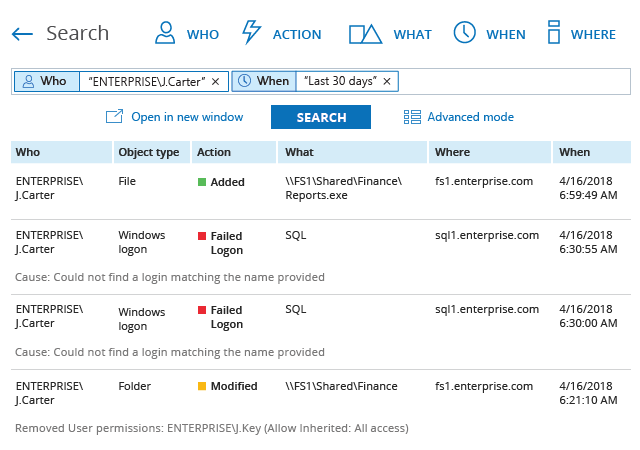
10.1 Establish a process for linking all access to system components (especially those done with administrative privileges such as root) to each individual user. Full features auditing and reporting of all administrative activity within Active Directory, Group Policy, file servers, virtualization environments, SQL Server, etc. Detection of who changed what, when, andwhere.

AD Change Reporter

File Server Change Reporter

Change Reporter for VMware

SQL Server Change Reporter

AD Change Reporter / All Active Directory Changes

Group Policy Change Reporter / All Group Policy Changes

SQL Server Change Reporter / All SQL Server Changes

File Server Change Reporter / All File Server Changes

Change Reporter for VMware / All VMware Changes

10.2 Implement automated audit trails to reconstruct the required events. Complete audit trail processing capabilities for servers and workstations, both user-initiated and administrative activity.

Event Log Manager

AD Change Reporter

File Server Change Reporter

Change Reporter for VMware

SQL Server Change Reporter

AD Change Reporter / All Active Directory Changes

File Server Change Reporter / All File Server Changes

Change Reporter for VMware / All VMware Changes

SQL Server Change Reporter / All SQL Server Changes

Event Log Manager / All Events by Date

10.3 Record at least the following audit trail entries for all system components for each event: User identification, Type of event, Date and time, Success or failure indication, Origination of event, Identity or name of affected data, system component, or resource. Full information of every change: who changed what, when, where, in Active Directory, File Server, virtual machines, SQL Servers.

AD Change Reporter

File Server Change Reporter

Change Reporter for VMware

SQL Server Change Reporter

AD Change Reporter / All Active Directory Changes

File Server Change Reporter / All File Server Changes

Change Reporter for VMware / All VMware Changes

SQL Server Change Reporter / All SQL Server Changes

10.5 Secure audit trails so they cannot be altered. Securable file-based storage with optional SQL Server storage. Full featured rolebased access to all reports. Centralized collection, archiving, and consolidation of event logs to secure file-based storage. All modules All reports
10.6 Review logs for all system components at least daily. Full-featured web-based reporting functionality with predefined reports and ability to create custom reports on any type of collected data. Out-of-the box reports scheduled daily and sent via e-mail for review. All modules All reports
10.7 Retain audit trail history for at least one year, with a minimum of three months immediately available for analysis. Unlimited storage capabilities with efficient storage use to store up to 8 years of past audit trails and history of changes to system components and security settings. Full-featured web-based reporting for immediate access to all required data.

Event Log Manager

AD Change Reporter

File Server Change Reporter

Change Reporter for VMware

SQL Server Change Reporter

All reports

Download Free Trial One-to-One Demo Request Quote

See how Netwrix All-in-One Suite helps meet requirements of other regulations, such as HIPAA, FISMA, GLBA and SOX.

Disclaimer: This information is not intended to provide legal advice or substitute for the advice of an attorney.

Microsoft Gold Certified Partner